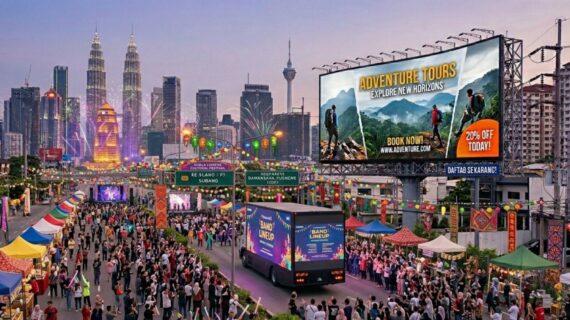
Mobile LED truck advertising can drive immediate smartphone interaction by combining QR codes, augmented reality triggers, and smart content design. Success depends on placement, timing, clear calls to action, and keeping interactive elements simple enough to engage audiences during brief windows—like traffic lights or slow-moving traffic.
Mobile advertising has always competed for attention. But truck advertising has entered a new era—one where a passing vehicle can prompt a consumer to pull out their phone, scan something, and take action, all before the traffic light turns green. The combination of mobile LED displays, QR codes, and augmented reality (AR) is turning moving vehicles into interactive brand experiences. The challenge? You have seconds, not minutes, to make it work.
This guide breaks down exactly how to design content for a moving vehicle that converts passive viewers into active participants.
Why Mobile LED Trucks Are Uniquely Suited to Smartphone Interaction
Unlike static billboards, mobile LED trucks bring the ad to the audience. They appear in high-footfall urban areas, at events, outside venues, and in slow-moving traffic—contexts where people are already on their phones or have a moment to pause.
The brief dwell time created by a red light or slow-moving traffic is actually an asset. Research in out-of-home (OOH) advertising consistently shows that consumers are more receptive to interactive prompts when they have a natural reason to stop. A 30–60 second window at a traffic light is, in advertising terms, a captive moment.
The key is designing content that respects that window—and uses it fully.
How to Design QR Codes That Actually Get Scanned on a Moving Vehicle
What makes a QR code scannable on a mobile LED truck?
Size and contrast are everything. A QR code on a moving vehicle needs to be significantly larger than you’d place on a printed flyer. As a general rule, the code should occupy at least 20–25% of the total display area when shown on screen.
A few non-negotiable design principles:
- High contrast background: White or light-coloured backgrounds with a dark QR code perform best. Avoid placing codes over busy imagery or gradient backgrounds.
- Error correction level: Set QR code error correction to level H (30% damage tolerance). This keeps the code functional even if part of the display is obscured or the viewer captures it at a slight angle.
- Dwell time alignment: Display the QR code prominently during the natural pause moments in your content loop—not buried in a transition. If your ad runs a 15-second loop, ensure the QR code is visible for at least 8–10 seconds.
- Shortened destination URLs: Use a URL shortener or branded domain so the destination is easy to remember if a scan attempt fails.
One practical addition: include a text prompt alongside the code. Something like “Scan now for 20% off” removes ambiguity and dramatically increases scan rates compared to a code alone.
Integrating Augmented Reality Into Mobile LED Truck Content
How does augmented reality work with truck advertising?
AR integration in OOH advertising typically works in one of two ways: marker-based AR (triggered by scanning the ad itself or a specific image) or location-based AR (triggered by GPS when a user is near the truck).
For mobile LED trucks, marker-based AR is the more reliable option. Here’s how the interaction typically flows:
- The LED display shows a bold prompt: “Point your camera here” or “Open [App Name] and scan”
- The viewer opens a compatible app—either a brand-specific app or a platform like Zappar, Blippar, or Snap’s AR Lens system
- The camera detects the marker on the truck display and triggers a 3D experience, animation, or interactive filter
The content of that AR experience matters enormously. Effective AR overlays for truck advertising include product demonstrations, gamified interactions (spin-to-win, reveal mechanics), or shareable filters that extend the campaign’s reach organically through social media.
Keep the AR entry point frictionless. If the interaction requires downloading a new app from scratch, most people won’t bother. Where possible, build AR experiences that work through a browser (WebAR) or an already widely-installed platform.
Timing and Content Sequencing for Maximum Engagement
What content structure works best for interactive LED truck ads?
The content loop on a mobile LED truck needs to do two things simultaneously: capture attention and communicate the interaction method before the window closes. A recommended structure for a 20–30 second loop:
- 0–5 seconds: Bold visual hook—movement, colour contrast, or a striking headline
- 5–15 seconds: Core message with brand context and the value proposition (“Exclusive offer inside”)
- 15–25 seconds: Clear interaction prompt—QR code, AR marker, or both—displayed large and with a direct instruction
- Final 5 seconds: Repeat the QR code with a urgency-based prompt (“Scan before you go”)
Repeat cycles matter. Most viewers won’t see the start of a loop. Designing content that communicates the full message and call to action at multiple points in the cycle ensures no one misses their opportunity.
Choosing Between QR Codes and AR: Which Is Right for Your Campaign?
Both QR codes and AR have a place in truck advertising, but they serve different goals.
Choose QR codes if:
- Your goal is direct conversion (e.g., driving traffic to a landing page, a discount, or a sign-up form)
- Your audience spans a wide age range and varying levels of tech familiarity
- You need measurable, trackable results quickly
Choose AR if:
- Brand experience and memorability are the primary objective
- Your campaign targets a younger, digitally engaged demographic
- You want organic social media amplification through shareable content
The strongest campaigns often combine both: a QR code as the primary, low-friction action and an AR experience as an optional, higher-engagement layer for those willing to go deeper.
Measuring Success: What Metrics Matter for Interactive Truck Advertising?
Tracking performance from a mobile LED truck campaign requires a few deliberate setups before launch:
- UTM-tagged URLs behind every QR code so you can track source traffic in Google Analytics
- Unique QR codes per route or location to identify which areas generate the highest scan rates
- AR session tracking through the platform you use (Zappar, Blippar, and similar platforms provide engagement dashboards)
- Time-of-day analysis to identify when your truck is most likely to be in slow-moving traffic—this is often when scan rates peak
Benchmarks vary by campaign, but a well-designed QR code on a mobile LED truck in a high-dwell urban environment can realistically achieve scan rates of 1–3% of estimated impressions—comparable to, and in some cases better than, digital display advertising CTRs.
Make Every Second Count
Mobile LED truck advertising rewards precision. The brands that see the strongest results from QR and AR integration are those that treat the 30–60 second dwell window as a creative constraint, not a limitation. They make the interaction obvious, the value clear, and the entry point effortless.
Start with one strong, trackable QR code before layering in AR. Test your content loop in real traffic conditions. And always design with the assumption that your viewer has one hand on the wheel and five seconds of genuine attention to give you.
That’s enough—if the content earns it.
Frequently Asked Questions
What size should a QR code be on a mobile LED truck display?
The QR code should occupy at least 20–25% of the total screen area. This ensures it remains scannable from a viewing distance of 5–15 metres, which is typical for roadside or traffic-light interactions.
What is the best QR code error correction level for outdoor advertising?
Level H (high), which tolerates up to 30% data damage. This is essential for outdoor environments where viewing angles, glare, and partial obstructions can affect scanability.
How long does someone typically have to scan a QR code at a traffic light?
Traffic light dwell time averages 30–90 seconds depending on the location and time of day. Effective truck ad content ensures the QR code is visible for at least half of that window, ideally with a clear instruction visible throughout.
Do augmented reality truck ads require a downloaded app?
Not always. WebAR platforms allow AR experiences to load directly in a mobile browser, removing the download barrier. However, app-based AR tends to offer richer experiences and better performance on older devices.
How do you track QR code scans from a mobile LED truck campaign?
Use UTM parameters in the destination URL and, ideally, a unique QR code per truck route or location. This allows you to attribute scans accurately in your analytics platform and identify which areas deliver the best engagement.